
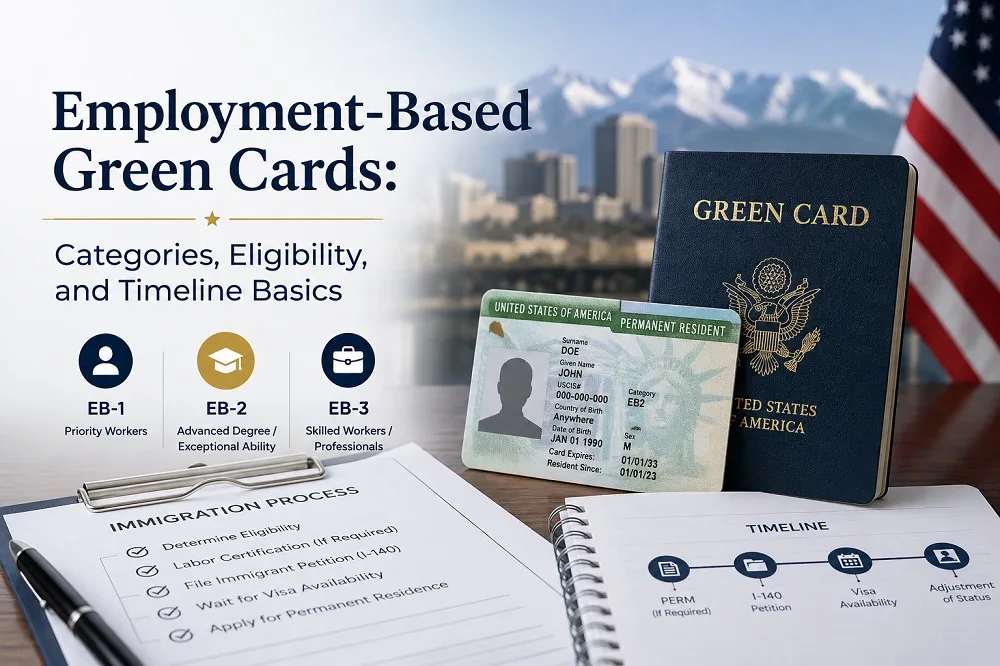
If you’re planning to live and work permanently in the United States through employment, understanding employment-based green cards is essential. The U.S. immigration system offers several employment-based categories, each with its own eligibility requirements, application process, and timeline.
Choosing the right category from the beginning can save time, reduce delays, and improve your chances of approval. Here’s an overview of the most common employment-based green cards, what each category requires, and what you can expect during the application process.
What Are Employment-Based Green Cards?
Employment-based green cards allow eligible foreign nationals to become lawful permanent residents based on their skills, education, work experience, or investment in the United States.
The most common categories include:
- EB-1: Priority workers with extraordinary ability, outstanding professors or researchers, and certain multinational executives or managers.
- EB-2: Professionals with advanced degrees or exceptional ability. Some applicants may qualify for a National Interest Waiver (NIW), which allows them to self-petition without employer sponsorship.
- EB-3: Skilled workers, professionals, and certain other workers sponsored by a U.S. employer.
Each category has different requirements, making it important to determine which option best fits your qualifications.
EB-1: Priority Workers
The EB-1 category is designed for individuals who have reached the top of their field or hold certain leadership positions.
Applicants may qualify if they are:
- Individuals with extraordinary ability in science, education, business, athletics, or the arts
- Outstanding professors or researchers
- Multinational executives or managers transferring to a U.S. employer
Many EB-1 applicants benefit from faster processing because this category often does not require PERM labor certification.
EB-2: Advanced Degrees and Exceptional Ability
The EB-2 category is intended for professionals who possess advanced education or exceptional ability.
Applicants generally qualify if they have:
- A master’s degree or higher (or a bachelor’s degree plus five years of progressive qualifying work experience) where an employer is willing to sponsor them.
- An employer willing to sponsor the petition, unless applying through a National Interest Waiver where a person has either an advanced degree or can develop exceptional ability. In addition, the applicant must prove that they have a proposal that has substantial merit and national importance, that they are in a strong position to have that proposal advance and that it is in the U.S.’s best interest to waive a labor certificate.
The EB-2 National Interest Waiver (NIW) is an attractive option for individuals
EB-3: Skilled Workers and Professionals
The EB-3 category is often used by employers to sponsor foreign workers for permanent positions.
Eligible applicants include:
- Skilled workers with at least two years of experience or training
- Professionals with a bachelor’s degree
- Certain other workers performing jobs requiring less experience
All EB-3 cases require both employer sponsorship and PERM labor certification before the green card petition can be filed.
Understanding the Employment-Based Green Card Process
Although every case is unique, most employment-based green card applications follow a similar process.
Step 1: Determine Eligibility
The first step is identifying the employment-based category that best matches your qualifications and career goals.
Step 2: PERM Labor Certification (When Required)
Most EB-2 and EB-3 employer-sponsored cases require PERM labor certification through the U.S. Department of Labor. This process confirms that no qualified U.S. workers are available for the position.
Step 3: File the Immigrant Petition
After labor certification is approved—or immediately for categories that do not require PERM—the employer (or applicant, in certain cases) files Form I-140 with U.S. Citizenship and Immigration Services (USCIS).
Step 4: Wait for a Visa Number
Applicants must wait until an immigrant visa number becomes available based on their priority date and visa category.
Step 5: Apply for Permanent Residence
When the priority date becomes current, applicants may file for adjustment of status if they are in the United States or complete consular processing if they are applying from abroad.
How Priority Dates Affect Processing Times
One of the most important factors affecting employment-based green cards is the visa bulletin published by the U.S. Department of State.
Each approved petition receives a priority date, which generally reflects when the immigration process officially began. Because annual visa numbers are limited, applicants must often wait until their priority date becomes current before moving to the final stage of the process.
Processing times vary depending on:
- Employment-based category
- Country of birth
- Annual visa availability
- USCIS and Department of Labor processing times
- Whether PERM labor certification is required
Monitoring the Visa Bulletin is an important part of long-term immigration planning.
Why Choosing the Right Category Matters
Selecting the wrong employment-based category can lead to unnecessary delays, additional costs, or even petition denials.
An experienced immigration attorney can evaluate your qualifications and determine whether you may qualify for:
- EB-1 priority worker classification
- EB-2 employer sponsorship
- EB-2 National Interest Waiver
- EB-3 skilled worker or professional category
Building the right strategy from the beginning often leads to a smoother immigration process.
How Buhler Thomas Law Can Help
Navigating employment-based immigration requires careful planning and a thorough understanding of immigration law. Whether you’re an employer sponsoring foreign talent or a professional pursuing permanent residence, Buhler Thomas Law provides personalized guidance throughout every stage of the process.
If you’re considering employment-based green cards in Salt Lake City, our team can help evaluate your eligibility, identify the most appropriate category, and prepare a strong application supported by the necessary documentation.
Build a Strong Foundation for Your Immigration Journey
Employment-based immigration is a significant investment in your future. Understanding the differences between EB-1, EB-2, and EB-3 categories—and choosing the right path from the start—can help you avoid delays and move toward permanent residency with confidence.
Whether you’re just beginning the process or exploring your options, Buhler Thomas Law is here to provide experienced legal guidance and help you pursue your long-term immigration goals.